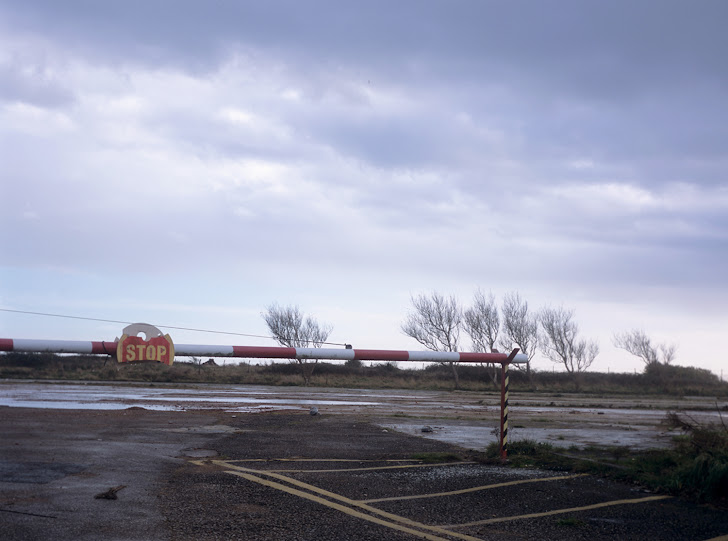
The scars of that post-industrial past can still be seen. The result of neglected places, often noosed by financial uncertainty, became difficult propositions; sites with To Let signs standing for years. During the 1980s and 90s the North was plagued with the aesthetic of dereliction and abandonment. Many buildings have now gone, a few have been reconstructed while some have been cleaned and transformed.
Tuesday, 25 October 2011
These peripheral spaces
When the North/North West of England's industries started to break down in the 1980s new questions were raised about the environment. Docklands and pits closed and other heavy industries went down adding to knock on effect and eventually creating a very changed landscape that felt worn, forgotten and broken.


Sunday, 12 June 2011
Its been two years since my last posting and I'm aware as will many be that sometimes life stands in the way of such indulgent tasks as blog-keeping. Well, I'm back and going to be changing the look of this blog-mag...
Absurdity is a wonderful wry thing we have but my concerns zip back to my work I followed upon graduating as a photographer at University of Central Lancashire (UCLAN) ; the wasteland project.
Beyond those first photo essays and mappings etc I managed to sift through many subject matters to finally find something I was satisfied with personally.
Wastelands have sub-consciously occupied my mind for over ten years and it is an ongoing project. A friend, fellow photographer and journalist, Antonia Charlesworth, (another former UCLAN student) has recently had BLUR magazine published as part of her MA. By featuring some of my work in there helped me to get back to it and focus on finalising some more printwork.
Although the work may seem a mile away from 'absurdities' and my previous 'walls and textural studies', to me its all fairly well linked in that they relate to marginal spaces.
Absurdity is a wonderful wry thing we have but my concerns zip back to my work I followed upon graduating as a photographer at University of Central Lancashire (UCLAN) ; the wasteland project.
Beyond those first photo essays and mappings etc I managed to sift through many subject matters to finally find something I was satisfied with personally.
Wastelands have sub-consciously occupied my mind for over ten years and it is an ongoing project. A friend, fellow photographer and journalist, Antonia Charlesworth, (another former UCLAN student) has recently had BLUR magazine published as part of her MA. By featuring some of my work in there helped me to get back to it and focus on finalising some more printwork.
Although the work may seem a mile away from 'absurdities' and my previous 'walls and textural studies', to me its all fairly well linked in that they relate to marginal spaces.
Friday, 15 May 2009
MORE OF THE STRANGE
In my archive I found a cut out policeman. The middle age man is found leaning blankly and not the least bit intimidating in Blackburn's shopping mall. Presumably he was there to deter any ideas that undesirables may have, let alone whether it was their intent in the first place to go and cause mischief. The idea that he stands over a number of elderly people sat on benches begs to make you wonder how he is protecting them. It's all too psychological and surreal. A cut-out-person is unsettling enough but one in uniform seems too far fetched and I think it's not just absurd but barking mad, whatever the 'ideas panel' thought at the time. Where are the real police?! I took this whilst studying a photography HND and I was amused by it all the way home to Preston.
Quirky maybe but still in the vein of juxtopositions my partner Alizon and I stumbled on someone selling combat trousers besides two religious icons; Mary and Jesus...perhaps I'm hitting too hard on the concepts of the ridiculous but it sparked something of a war and peace thing - enough for me to include it here along with another from the same day:
"Pain?"...Ok so it's a herbal stall. But...
"Ask me for a free trial."
Quirky maybe but still in the vein of juxtopositions my partner Alizon and I stumbled on someone selling combat trousers besides two religious icons; Mary and Jesus...perhaps I'm hitting too hard on the concepts of the ridiculous but it sparked something of a war and peace thing - enough for me to include it here along with another from the same day:
"Pain?"...Ok so it's a herbal stall. But...
"Ask me for a free trial."
Sunday, 24 August 2008
TV guide
The image of the TV helping to mark out the boundary of a dug-out hole is curious and sings back to me the style of commentary that Richard Wentworth was observing in London. My partner Alizon pointed this out to me just around the corner from our house in Alhama de Granada, Spain. Obviously it means little to the people who arranged it but looking from the outside of the situation it seems comical and absurd.
Friday, 9 May 2008
Fleetwood and neighbouring towns
Blackpool has always been coastal king when it comes to the attraction: seaside amusements, the Pleasure Beach, tat and tack, the promenade and piers and of course the Tower. Morecambe seems more subdued and melancholic although the town awaits an influx of visitors as the fantastically re-vamped Art Deco Midland hotel rises again and the town's biggest focus right now - the Eden Project, is stirring interest as it looms on the Bay's horizon. Morecambe's Vintage weekend is a great crowd puller too in September.
I really like Morecambe while Southport, at least to me, feels more like the posher end of northern seaside culture with its outsiderness from Liverpool, the Victorian shop fronts. (All towns should have the same styled canopies to stop the battering rain).
Fleetwood on the other hand is a place that Lancashire seems has forgotten about. Its better fishery days long gone, its pier gone, a line of squat shops selling sun-bleached postcards and garish stuff for kids. As ever I'm drawn to these fringe towns and their awkward spaces. People wander about on the 'proms', couples nest in the dunes, while others sit in their cars and watch the sea, with their chips.
I really like Morecambe while Southport, at least to me, feels more like the posher end of northern seaside culture with its outsiderness from Liverpool, the Victorian shop fronts. (All towns should have the same styled canopies to stop the battering rain).
Fleetwood on the other hand is a place that Lancashire seems has forgotten about. Its better fishery days long gone, its pier gone, a line of squat shops selling sun-bleached postcards and garish stuff for kids. As ever I'm drawn to these fringe towns and their awkward spaces. People wander about on the 'proms', couples nest in the dunes, while others sit in their cars and watch the sea, with their chips.
They have a tram day in Fleetwood and no one can be bothered. The song Everyday is like Sunday springs to mind, which is unfair because rumour was the song was about everywhere else - Morecambe, Southport, Hartlepool, and actually filmed in Southend-on-Sea. We're left with rumour and unknowing which adds to these windswept coastal towns.
Monday, 28 April 2008
Non-place and uncertain spaces
Psychogeography is a good companion to the random thinking flaneur who wanders with a camera. I've always been drawn to marginal places and spaces. Photography is an absolute passion and the timing of the shutter firing fits my own attention span on the world. The urban experience is different to me everyday. Saying that, I do have interests that are central to the city and its edges. What sometimes seems like aimless wandering is justified by this random mapping - finding material subjects that fit the projects I concentrate on, such as ruin, wasteground, non-places, textures, walls, palimpsests, odd wording, letters, objects on the ground, the list goes on. Robert Frank once said 'you can photograph anything these days'. Its true, and most people are photographers as well. But its how you collate, edit' and present work that helps a working photographer to find an interested audience.
Beyond the spaces of ruin and wastelands that often lay forgotten are the evergrowing number of new buildings, the shining glass exteriors of offices and group companies that are like mini-mirrors of beast capitals like Bejing and Tokyo, New York and London. At the city fringes, along side the dead garages and waste grounds are the non-place (a name coined by French philosopher and anthropologist Marc Auge). These new filled spaces are transitory states through which we move through - often very slowly and mechanically, for transactional and security purposes: airports, retail parks, ATM queues, the new 'malls' and peripheral supermarkets. There are dozens of other examples of non-places. A recent photograph I took shows a sample of a new 'exclusive home zone'(see Lytham below). Near to this was a 'Marketing Suite' where flags waved proudly on clipped lawns and not a soul in sight. These are the cold-edged marginal spaces within their own worlds, disconnected to ruins and places of history and identity. Months before (and left for years)this was a wasteland where people walked.
Beyond the spaces of ruin and wastelands that often lay forgotten are the evergrowing number of new buildings, the shining glass exteriors of offices and group companies that are like mini-mirrors of beast capitals like Bejing and Tokyo, New York and London. At the city fringes, along side the dead garages and waste grounds are the non-place (a name coined by French philosopher and anthropologist Marc Auge). These new filled spaces are transitory states through which we move through - often very slowly and mechanically, for transactional and security purposes: airports, retail parks, ATM queues, the new 'malls' and peripheral supermarkets. There are dozens of other examples of non-places. A recent photograph I took shows a sample of a new 'exclusive home zone'(see Lytham below). Near to this was a 'Marketing Suite' where flags waved proudly on clipped lawns and not a soul in sight. These are the cold-edged marginal spaces within their own worlds, disconnected to ruins and places of history and identity. Months before (and left for years)this was a wasteland where people walked.
Monday, 24 March 2008
The absurd
In the photographs of the artist Richard Wentworth he observes our daily eccentricities in and about the streets of London and beyond. His Making Do and Getting By study looks at ordinary things that suddenly become quirky or much more odder, now that they are turned into photographs. They are singular gestures such as propping up an old flaky window with a coffee mug or placing a polystyrene cup on a spiky railing.
Although his work has informed me about our strange ways, the type of photographs that I am taking tends to be within the region I live in Lancashire in the North West. The information I want to gather is similar in visual tones but the messages are slightly different and more to do with the ridiculous than the sublime, and more with absurdity than resourcefulness and making-do.
Sometimes the surrealism leans in too. This is an area where many photographers of the past can be aligned. Surrealism has been suggested into Eugene Atget’s photography, Andre Kertesz’s, Henri Cartier-Bresson’s and dozens of others throughout the 20th Century. It’s a deeper subject that swamps the darker recesses of reality and too sprawling for me to be a master of its text but its also personal and viewed through a camera can create some strange and mixed communications.
Weird images may be strange but does that mean the photographer is strange? For instance, the Shop Window taken in Southport is, in part, an unconscious array of gifts gathered to sell. But as an image it doesn’t really make me want to buy, apart from not being an Alsatian, Elvis or Victorian scary doll fan. It’s the combination of these things, well that and the dog’s tongue, that make it darkly comic. Ironically, it’s probably not a photograph you’d want on your wall either.
Although his work has informed me about our strange ways, the type of photographs that I am taking tends to be within the region I live in Lancashire in the North West. The information I want to gather is similar in visual tones but the messages are slightly different and more to do with the ridiculous than the sublime, and more with absurdity than resourcefulness and making-do.
Sometimes the surrealism leans in too. This is an area where many photographers of the past can be aligned. Surrealism has been suggested into Eugene Atget’s photography, Andre Kertesz’s, Henri Cartier-Bresson’s and dozens of others throughout the 20th Century. It’s a deeper subject that swamps the darker recesses of reality and too sprawling for me to be a master of its text but its also personal and viewed through a camera can create some strange and mixed communications.
Weird images may be strange but does that mean the photographer is strange? For instance, the Shop Window taken in Southport is, in part, an unconscious array of gifts gathered to sell. But as an image it doesn’t really make me want to buy, apart from not being an Alsatian, Elvis or Victorian scary doll fan. It’s the combination of these things, well that and the dog’s tongue, that make it darkly comic. Ironically, it’s probably not a photograph you’d want on your wall either.
Subscribe to:
Posts (Atom)
Locked gates

Bridge at Vernon's
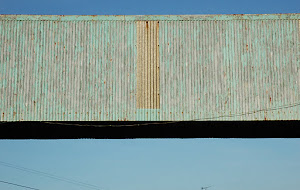
Percy St, Preston
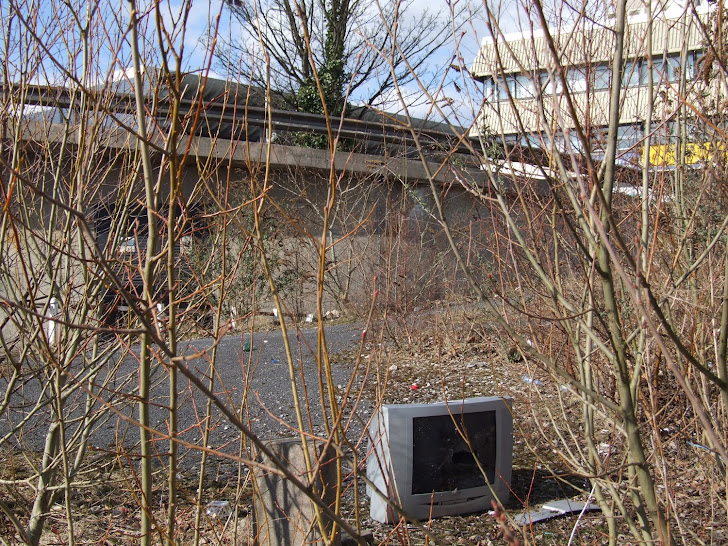
Once: a social club
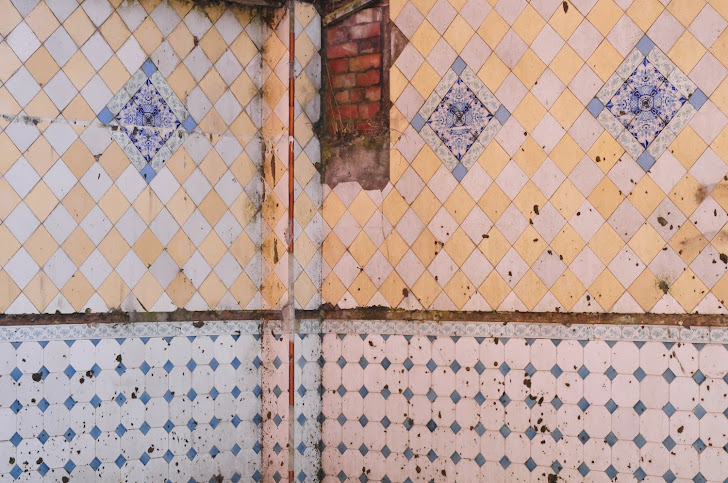
Church St tiled walls
Wasteland